Sung Sot translates as “Surprise” in Vietnamese, and the cave delivers exactly that: a narrow entrance cut into the limestone face of Bo Hon Island opens without warning into a chamber tall enough to hold 1,000 people.
Located in the heart of Halong Bay, a UNESCO World Heritage Site, Sung Sot Cave is the largest grotto in the bay and one of the most visited natural landmarks in northern Vietnam.
This guide covers everything you need before stepping aboard a boat toward Bo Hon Island: the history and folklore behind the cave, a chamber-by-chamber description of what you will find inside, clear logistics for getting there, the best months and times of day to visit, and practical preparation tips.
Overview of Sung Sot Cave
Sung Sot Cave takes its name from the reaction of the first Westerner known to have found it. A French explorer reached the cave in 1901 and was so taken aback by the scale of the interior that he named it Grotte des Surprises, meaning Surprise Grotto in French. Translated into Vietnamese, the name became Hang Sung Sot, carrying the same meaning.
The cave remained largely inaccessible to visitors for decades and did not open to tourism until 1993. Since then it has become a central stop on almost every Halong Bay itinerary.
The cave sits within Halong Bay’s UNESCO-designated core zone, part of a seascape that has held World Heritage status since 1994. Beyond its geological credentials, Sung Sot holds a meaningful place in Vietnamese cultural memory through its connection to the legend of Thanh Giong.
According to local tradition, this hero defended the ancient Van Lang kingdom against Chinese invasion during the reign of the Hung Kings. After the battle, Thanh Giong rode his iron horse skyward from the bay. Rock formations inside the cave, including a mass shaped like a horse, sword-like stalactites, and small pools on the cave floor, are said to mark the traces he left behind. Whether you receive the legend as mythology or history, it gives the formations inside a second layer of meaning that purely geological descriptions cannot offer.
For travelers exploring the broader cave landscape of Halong Bay, this cave is one of eight celebrated grottos along the bay’s heritage circuit, each with its own distinct character.
Inside Sung Sot Cave: A Walk Through the Three Chambers
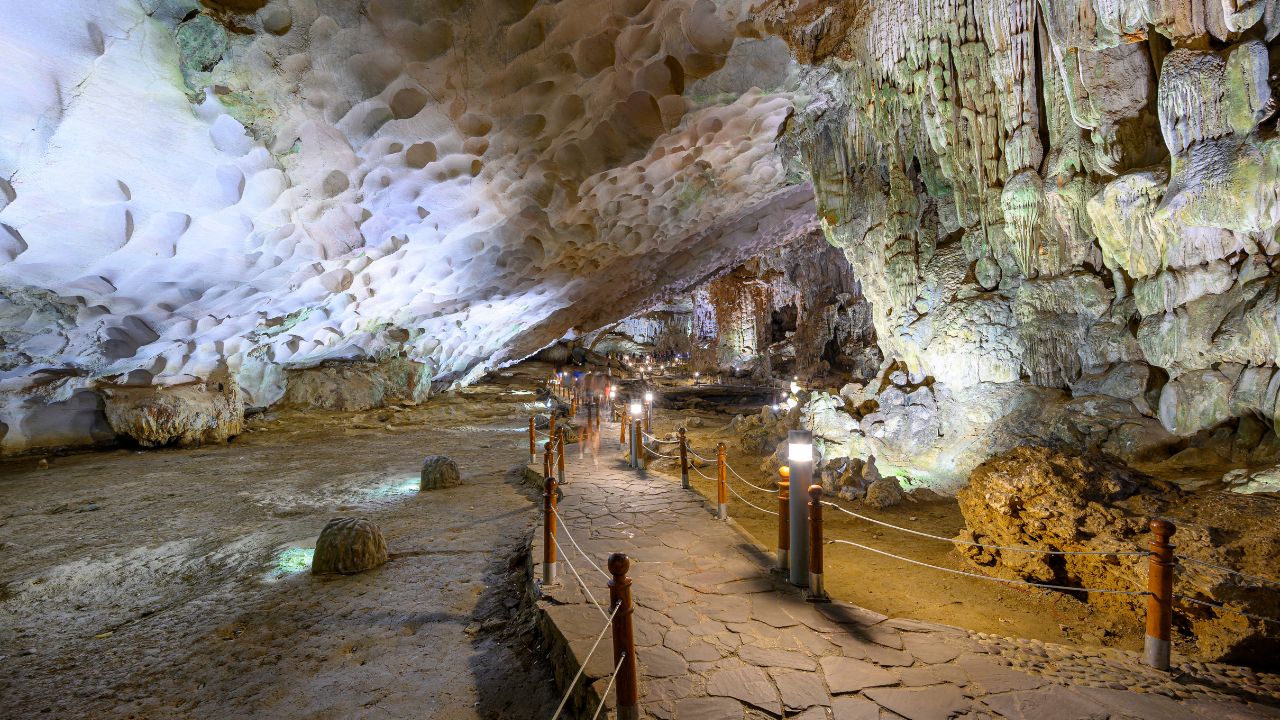
Sung Sot Cave spans approximately 10,000 square meters (about 107,600 square feet) and reaches a ceiling height of up to 30 meters (around 98 feet) at its tallest point. The cave runs for roughly 800 meters (half a mile) along a one-way walking path, divided into three distinct sections.
From Bo Hon Wharf, you climb approximately 100 stone steps through dense, humid forest. As you rise, the bay opens behind you in flashes through the canopy. Then the entrance appears: a narrow, unremarkable gap in the rock face that gives no indication of what follows.
Chamber 1: The Waiting Room
The first chamber sits roughly 5 meters (16 feet) below the entrance level and covers approximately 300 square meters. Its ceiling rises sharply overhead, hung with stalactites that many guides and visitors compare to chandelier formations in an opera house. A shallow lake occupies part of the floor, fed by rainwater filtering through the limestone above. The water is clear enough to see the bottom.
Chamber 2: The Hall of Legends
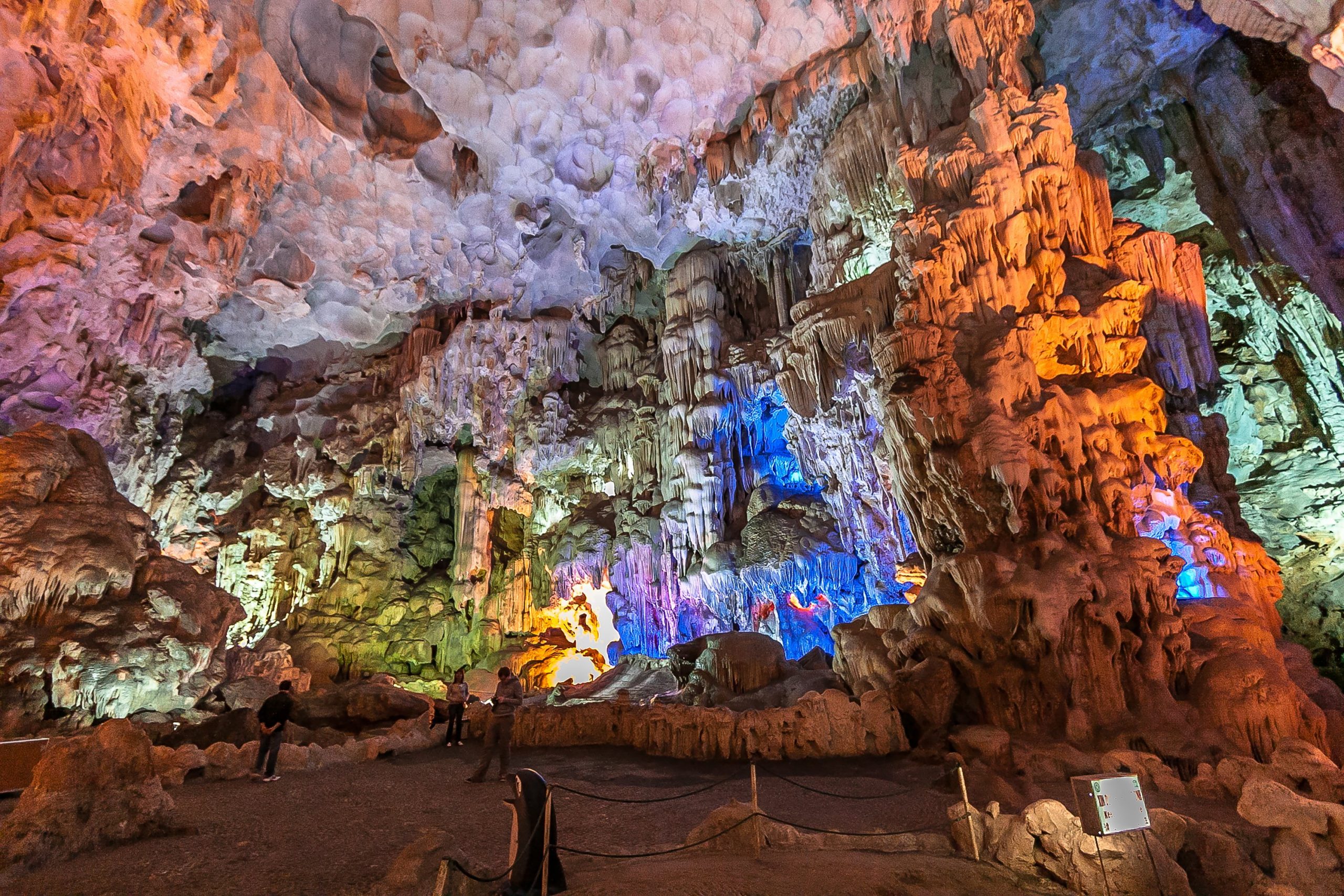
The second chamber is more than twice the size of the first, covering over 600 square meters and opening into a cathedral-like space. Thousands of small natural holes in the ceiling allow airflow, keeping this section cooler and better ventilated than the entry chamber. This is where the Thanh Giong legend becomes visible. A large rock mass on one side of the chamber resembles a horse mid-stride. Nearby, sword-shaped stalactites hang at angles that align with the story. Small depressions on the cave floor, filled with still water, are described by guides as the hoofprints of the hero’s steed. The LED lighting system shifts color slowly, changing the mood of the space every few minutes.
Chamber 3: The Royal Garden
The third and final section is the most unexpected. Natural daylight enters through openings in the rock face above, warming the temperature and illuminating green vegetation growing from the cave walls and floor. A clear lake sits near the far end. Birds call from overhead. Monkeys occasionally appear on the limestone ledges. The path exits onto an open terrace with a panoramic view of Halong Bay’s karst landscape: dozens of limestone islands rising from flat, green water as far as the eye can see.
How to Get to Sung Sot Cave?
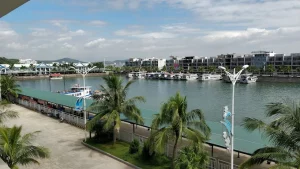
Sung Sot Cave sits on Bo Hon Island, approximately 14 kilometers (8.7 miles) from Bai Chay Tourist Wharf in Ha Long City. The cave is accessible only by water.
The most common independent option is the Route 2 day-boat ticket, available at Tuan Chau International Passenger Port and Ha Long International Cruise Port. Route 2 covers Sung Sot Cave, Ti Top Island, Me Cung Cave, Trinh Nu Cave (or Luon Cave), and Dong Tien Lake within a six-hour circuit.
Visitors with a tighter schedule can hire a private canoe from the city’s main wharves for a more direct approach. The majority of international travelers, however, reach the cave as part of a two-day or three-day overnight cruise, where the cave sits within a full itinerary alongside kayaking, onboard dining, and other bay highlights.
| Access Option | Approx. Cost (2026) | Best For |
|---|---|---|
| Route 2 Day Boat (Tuan Chau Port) | From 290,000 VND per person | Budget day visitors |
| Private Canoe Charter | From 1,200,000 VND per hour (4 to 8 seats) | Small groups, flexible timing |
| Overnight or Multi-Day Cruise | Varies by operator and duration | Most immersive experience |
All prices are approximate, based on available 2026 data, and subject to change. Please confirm current rates with your operator before booking.
Best Time to Visit Sung Sot Cave
The cave maintains a relatively stable internal temperature year-round, typically between 20 and 23 degrees Celsius (68 to 73 degrees Fahrenheit). The season you choose, however, affects crowd levels, sea conditions, and the overall quality of your visit considerably.
| Season | Conditions | Crowd Level |
|---|---|---|
| March to May | Mild, low rain, calm seas | Low to moderate |
| June to August | Hot, storm risk in July and August | High (domestic peak) |
| September to November | Comfortable, good visibility | Moderate |
| December to February | Dry, cool, clear | Moderate (international peak) |
Whatever month you choose, the time of day you arrive makes a difference. The cave opens daily from approximately 7:00 AM and closes around 5:00 PM. Reaching Bo Hon Island before 9:00 AM or after 3:00 PM keeps you clear of the midday rush, when multiple boats dock at the island simultaneously. Most visitors complete the cave walk in 40 to 60 minutes.
Practical Tips Before You Visit
A few preparations make a meaningful difference to the experience inside Sung Sot Cave.
- Wear closed-toe shoes with a grip sole. The stone steps to the entrance and some sections of the internal path can be slippery in humidity. Sandals and smooth-soled footwear increase the risk of a fall.
- Dress in light, breathable layers. The external climb is warm, particularly from May to September. The cave interior is noticeably cooler than outside temperatures.
- Carry water. There are no vendors inside the cave itself. The full walk from boat to exit typically takes 45 minutes or more.
- Set your camera to low-light or night mode. Flash photography is not permitted inside. The colored LED lighting creates striking scenes, but automatic flash tends to flatten the depth of the formations.
- Do not touch the stalactites or stalagmites. Oil from skin contact disrupts the calcium carbonate formations, which took thousands of years to develop.
- Follow the one-way path throughout. The route does not loop. Once you pass a section, you continue forward to the exit. Visitors with significant mobility limitations should discuss the route with their operator before booking, as there is no alternative access or elevator.
Sung Sot Cave and Your Halong Bay Cruise
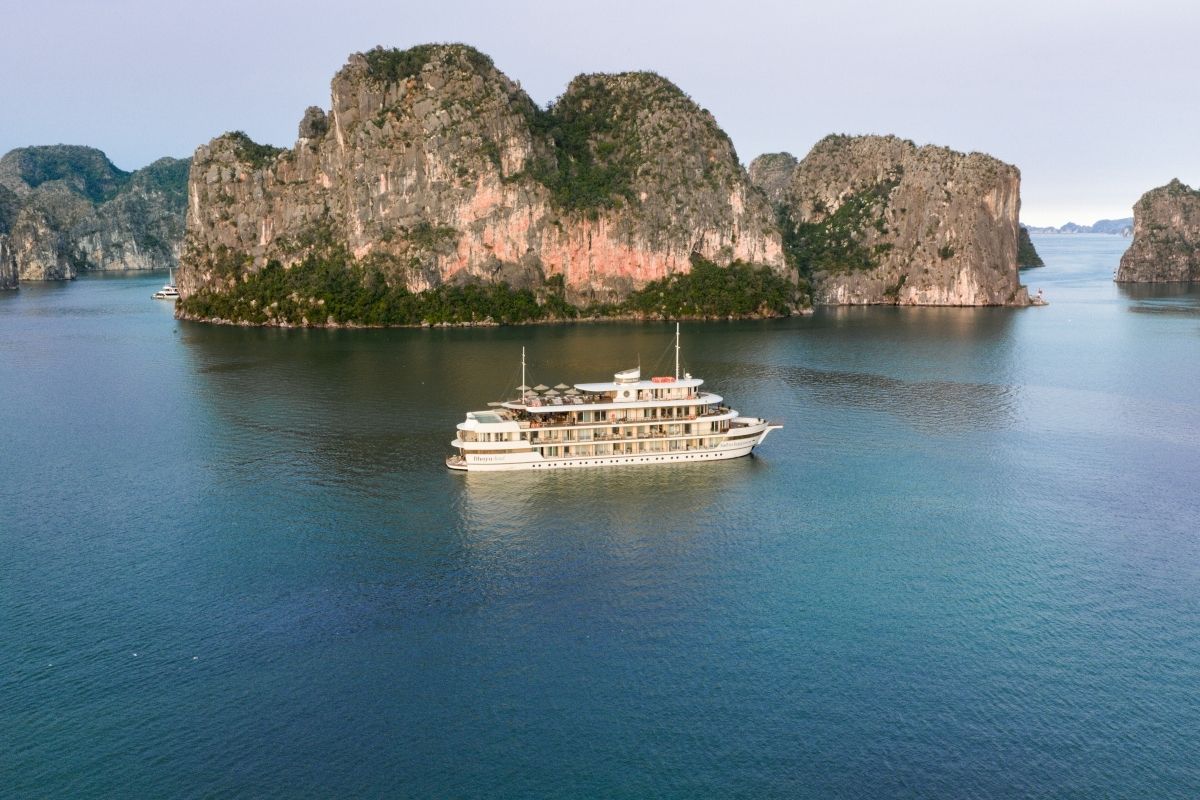
Sung Sot Cave is one point on a much larger seascape, and the most rewarding way to experience it is to arrive slowly by water. The journey from Ha Long City takes roughly 90 minutes by boat through open bay water before the karst islands close in around you. By the time you reach Bo Hon Island, the scale and stillness of Halong Bay have already made their impression.
Almost every overnight cruise in Halong Bay includes the cave as a central itinerary stop. It sits naturally alongside Ti Top Island, Luon Cave (reached by kayak through a low limestone arch), and Trinh Nu Cave, all close neighbors on the Route 2 circuit.
Travelers who want a deeper immersion in the bay’s landscape will find Bhaya Soul a considered choice. These boutique wellness cruises are built around an unhurried pace: sunrise meditation, stargazing on sundeck, fresh Vietnamese cuisine prepared onboard, spa treatments between island stops, and the kind of quiet that comes only from open water at night. On a Bhaya Soul itinerary, the cave visit becomes one element of a longer, more deliberate journey rather than a single attraction to check off. Discover Bhaya Soul’s wellness cruises on Halong Bay.
Conclusion
Sung Sot Cave rewards those who arrive without rushing. The surprise it delivers is not only the size of the interior but the way each chamber shifts the register of the experience, from the intimate stillness of the Waiting Room to the open daylight and birdsong of the Royal Garden.
Planning your Halong Bay itinerary? Whether you are drawn to the wellness-focused voyages of Bhaya Soul or a multi-bay exploration across Halong and Lan Ha with The Au Co, Bhaya’s collection of boutique cruises ensures the cave becomes a memory rather than a checkbox. Explore Bhaya Cruises to find your voyage.
Frequently Asked Questions
Is Sung Sot Cave worth visiting?
Yes. Sung Sot Cave is the largest cave in Halong Bay by total area and features three distinct chambers, each offering a unique combination of natural formations and cultural significance. A complete visit typically takes 40–60 minutes and requires moderate fitness due to the stone staircase leading to the entrance.
How many steps are there at Sung Sot Cave?
Visitors climb approximately 100 stone steps from Bo Hon Wharf to the cave entrance, ascending to around 25 metres (82 feet) above sea level. Inside the cave, the route continues across uneven surfaces with gentle elevation changes between the three chambers.
Can I visit Sung Sot Cave without an overnight cruise?
Yes. Sung Sot Cave can be visited on a Route 2 day cruise departing from Tuan Chau International Passenger Port or Ha Long International Cruise Port. The six-hour itinerary includes the cave along with several other attractions in Halong Bay. Private canoe charters from Ha Long City are also available for small groups.
What is the entrance fee for Sung Sot Cave?
As of 2026, the entrance fee is approximately 300,000 VND per person (around 12 USD). Visitors joining a Route 2 day tour will typically have the cave entrance included in the ticket price, while the fee is also included in most overnight cruise packages. As pricing may change, it is advisable to confirm current rates with your tour operator before travelling.
What is the best time of day to visit Sung Sot Cave?
The best time to visit is before 9:00 AM or after 3:00 PM, when the cave is generally less crowded. Between approximately 10:00 AM and 2:00 PM, multiple cruise boats arrive at Bo Hon Island, making the pathways and chambers significantly busier.