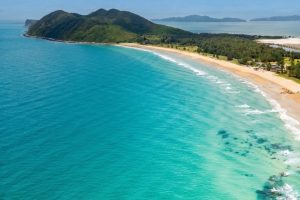
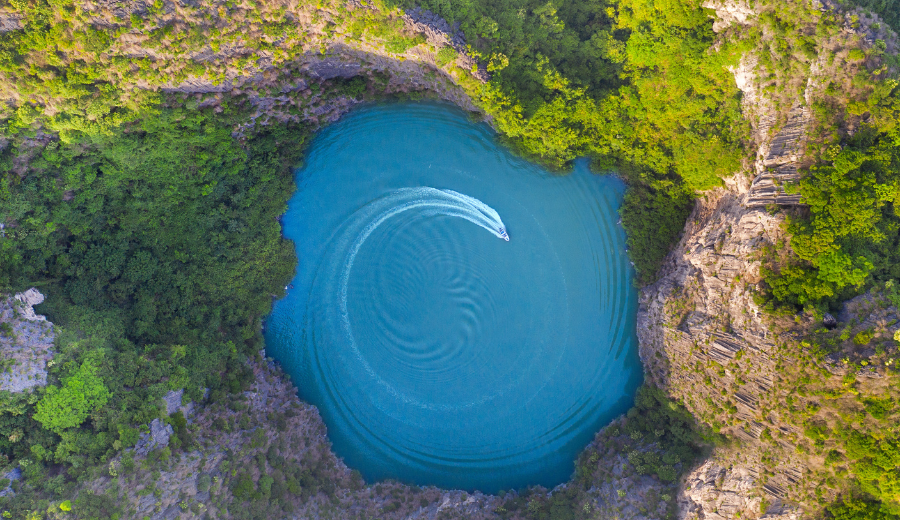
Ba Ham Lake, located on Dau Be Island in the quieter southern reaches of Lan Ha Bay, this formation sits well beyond the standard cruise corridors, accessible only at low tide through a sequence of narrow cave passages carved into limestone karst. What waits on the other side is not a single body of water but three enclosed saltwater basins, each with its own character, connected by tunnels that open without warning into pools of deep emerald green.
This guide covers the geology and history of Ba Ham Lake, a detailed breakdown of its three lakes and connecting caves, the activities available, the best time to visit in 2026, and how to include this destination in a Lan Ha Bay cruise itinerary.
Overview of Ba Ham Lake
Ba Ham Lake translates directly as “Three Tunnel Lake,” which describes the formation more accurately than “lake” alone suggests. It is, in geological terms, a sunk karst depression, or fengcong terrain, where the earth collapsed inward and the resulting basins filled with seawater.
This is not a freshwater mountain lake fed by rainfall. The three basins are saltwater, connected directly to the sea through their underground passages, and their water levels rise and fall with the tides.
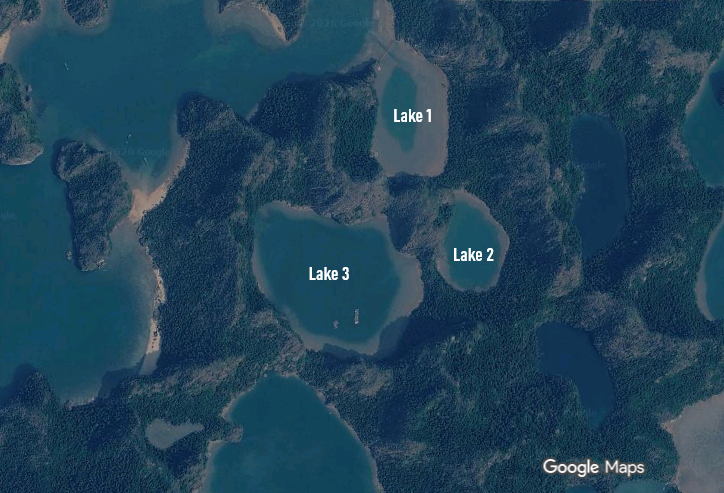
The three lakes vary considerably in size.
- Lake 1 covers approximately 4.2 hectares with an average depth of 2 to 5 metres.
- Lake 2 is the largest, spanning 23.2 hectares and reaching depths of 10 to 15 metres, its walls draped with vegetation from the karst ridge above.
- Lake 3 is the smallest at 1.05 hectares, with an average depth of 2 to 4 metres, and is often the most tranquil of the three.
Ba Ham Lake is part of the Ha Long Bay – Cat Ba Archipelago, which the UNESCO World Heritage Committee formally recognised for its geology and geomorphology in 2000. The Committee cited exactly this type of terrain – peak-cluster depression karst, or fengcong – as one of the site’s most significant geological features.
The earliest known written documentation of Ba Ham Lake appeared in the 1938 French publication “Merveille de Monde,” a guide to remarkable natural sites worldwide. At that time, Ba Ham was noted alongside Sung Sot Cave and Luon Cave as a formation of equivalent but distinct character. That historical record adds a layer of depth that most natural attractions in the region cannot claim.
Where Is Ba Ham Lake Located?
Ba Ham Lake sits on Dau Be Island, part of the Dau Be island cluster at the southwestern edge of Lan Ha Bay. Lan Ha Bay lies within Hai Phong province, administratively distinct from Halong Bay proper, which falls under Quang Ninh province.
Dau Be Island is one of the outermost island groups in the broader heritage area, positioned where the bay meets the open Long Chau Sea. From Cat Ba Town, the boat journey to Ba Ham Lake takes approximately 45 to 55 minutes, depending on vessel type and sea conditions.
For travelers arriving from Hanoi, the journey to the cruise departure point – typically Tuan Chau International Port or Cat Ba Island – takes approximately 2.5 to 3 hours by road via the Hanoi–Halong expressway. From Cat Ba Island, access to Lan Ha Bay is more direct and suits itineraries that specifically include the Dau Be corridor.
| Reference Point | Approximate Journey Time |
|---|---|
| Hanoi to Tuan Chau International Port | 2.5 to 3 hours by road |
| Cat Ba Town to Ba Ham Lake | 45 to 55 minutes by boat |
Ba Ham Lake is included within the Ha Long Bay – Cat Ba Archipelago World Heritage Site boundary. Travelers planning to visit should confirm that their cruise itinerary covers the Lan Ha Bay zone and that the operator holds the relevant permits for Dau Be Island access.
The Three Lakes and Three Tunnels Explained
Ba Ham Lake is best understood as a sequence, not a single destination. The formation moves from a wide outer basin through progressively narrower and more intimate spaces, with each transition requiring passage through a cave tunnel.
- Lake 1 is the entry point. Wide and roughly circular, it is the first basin visitors reach after navigating Cave 1, an approximately 120-metre passage with an entrance width of around 27 metres. This entrance floods at high tide, making it completely impassable until the water recedes. Inside Lake 1, limestone walls rise vertically around the perimeter. Orchids, cycas pectinata, fig trees, and banyan grow along the upper ridges, their roots finding purchase in narrow ledges above the waterline.
- Cave 2 connects Lake 1 to Lake 2. It runs approximately 40 metres in length with a width of around 15 metres. Like Cave 1, it is tidal, and passage requires low-water conditions. Stalactites hang from the ceiling throughout, shaped by thousands of years of mineral accumulation. The light inside shifts from near-darkness to reflected green as the cave opens into Lake 2.
- Lake 2 is the largest of the three basins, and its scale often surprises visitors. At 23.2 hectares and up to 15 metres deep, it feels more like an open lagoon than an interior lake. The surrounding karst ridges are dense with tropical vegetation. Long-tailed macaques have been observed moving through the tree line above, and birdlife including parrots is active during the morning hours.
- Cave 3 connects Lake 1 to Lake 3 via a narrower passage of approximately 50 metres and 5 metres in width. This is the most confined of the three tunnels, and kayakers must navigate carefully. The sense of isolation deepens here as the passage twists before opening.
- Lake 3 is the smallest and the most enclosed. At 1.05 hectares, it sits in near-complete stillness. Bats roost in the upper cave sections and are visible through the water in the shallower areas. Visibility into the lakebed is highest here due to the calmer surface conditions.
The wildlife within and above the lake system is notable. Long-tailed macaques, flying squirrels, bats, and parrots inhabit the island interior. The saltwater beneath supports a range of marine species visible in the shallower basins.
Tidal Access: Why Timing Matters
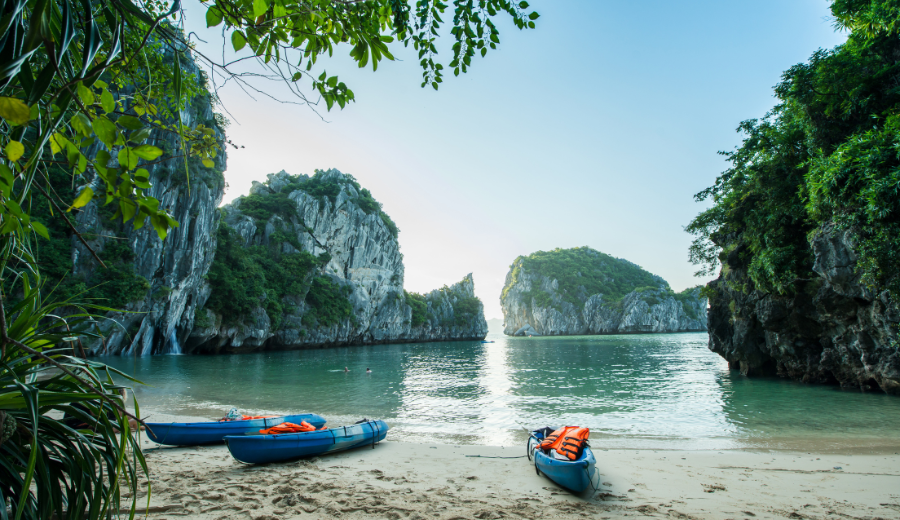
Access to Ba Ham Lake is entirely controlled by the tides. All three cave entrances flood at high tide, making the formation completely inaccessible during those windows. Cruise operators and day-tour providers schedule visits around low-tide periods, which shift daily and vary by season.
This is the primary reason Ba Ham Lake does not appear on standard Halong Bay itineraries. Its inclusion requires deliberate planning at the scheduling stage, and even confirmed itineraries may be adjusted if tidal conditions change. Travelers interested in visiting should raise this specifically when booking and confirm the low-tide window in advance.
Tidal access times change by season and year. Always confirm the current low-tide schedule with your cruise operator or local guide before finalising your visit plans.
Things To Do in Ba Ham Lake
Kayaking is the primary way to experience Ba Ham Lake, and for most visitors it is the defining activity of the visit. The cave passages are navigated by kayak or sampan rowing boat, and the lakes themselves are best explored at a slow pace that allows time to observe the cave architecture, the reflections on the water surface, and the wildlife above.
For travelers who prefer not to paddle, local bamboo rowing boats (sampan) offer an alternative. These carry groups of six to seven passengers and are operated by local rowers familiar with the tunnel passages. The sampan journey is slower and more passive but provides the same access to all three lakes.
Wildlife observation is best undertaken from a stationary kayak in the early morning, when macaque activity along the treeline is highest and the light is low across the water. A waterproof case for cameras and phones is strongly recommended. The passage between Lake 1 and Lake 2, where light enters from both ends of Cave 2, produces the most distinctive photographic conditions.
Swimming access inside the lakes depends on current operator guidelines and local authority permissions, which are subject to change. As of 2026, visitors should confirm swimming permissions with their cruise operator rather than assuming access. The enclosed ecosystem within Ba Ham Lake is protected, and responsible visitors follow the guidance of their guides throughout.

When Is the Best Time to Visit Ba Ham Lake?
The best conditions for visiting Ba Ham Lake in 2026 fall between October and April. During this period, the Gulf of Tonkin is generally calmer, visibility across the water is clearest, and the cave passages can be navigated with greater predictability.
| Period | Weather | Visitor Conditions |
|---|---|---|
| October to December | Cool, dry, clear skies | Peak conditions; more boat traffic, higher prices |
| January to April | Mild, good visibility, fewer crowds | Best balance of weather, access, and value |
| May to September | Hot, humid, typhoon-season risk | Possible closures or itinerary changes, sea conditions variable, there’s good summer deals |
Weather and access conditions change seasonally and may vary year to year. Please confirm the latest situation with your cruise operator before booking.
How to Visit Ba Ham Lake on a Cruise from Halong or Lan Ha Bay?
Ba Ham Lake is not included in standard central Halong Bay itineraries. Reaching it requires a cruise that specifically routes through the Lan Ha Bay southern corridor and includes Dau Be Island as a scheduled stop. When booking, travelers should confirm in writing that Ba Ham Lake is part of the planned route and that the operator holds the relevant permits.
Most cruises that cover Ba Ham Lake run on a two-day or three-day schedule. A two-day itinerary allows a single full day of Lan Ha Bay exploration with Ba Ham Lake as the primary kayaking stop. A three-day itinerary provides more time for the broader southern corridor and for combining Ba Ham Lake with other formations in the area, including Tien Ong Cave, Ang Du, and the Cua Van floating village.
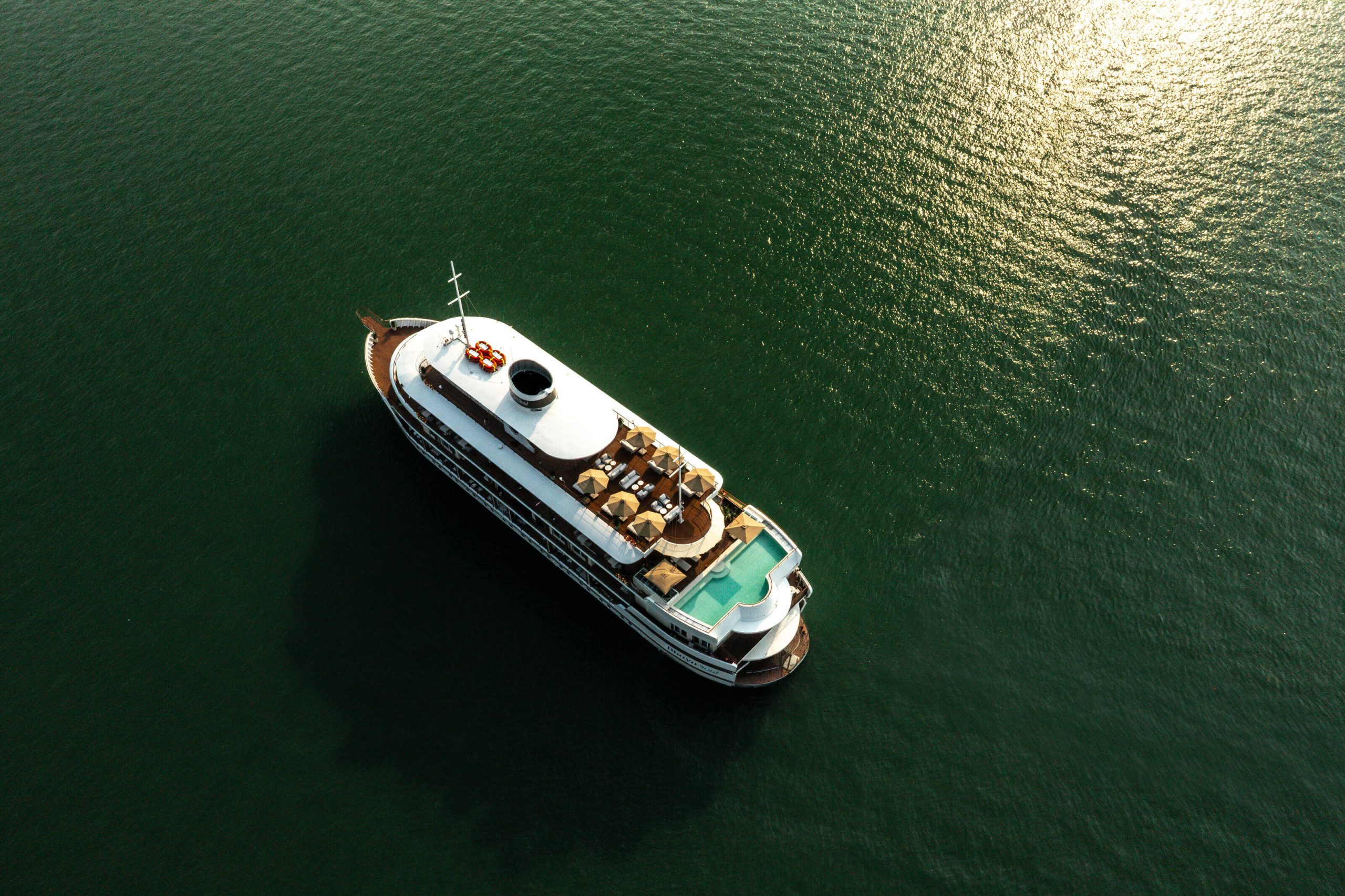
Bhaya Soul offers multi-day boutique wellness cruises that are well suited to this kind of itinerary. Onboard sleeping well meditation on deck, spa treatments, and health-conscious dining create a pace that complements the slowness of kayaking through enclosed saltwater lakes. For travelers who want the natural experience without the compromise of rushed scheduling, Bhaya Soul’s route structure through Lan Ha Bay provides the right rhythm. The calm of paddling through Ba Ham Lake and the restoration of an evening meditation session on the water are experiences that reinforce each other in a way that a day-trip format does not allow.
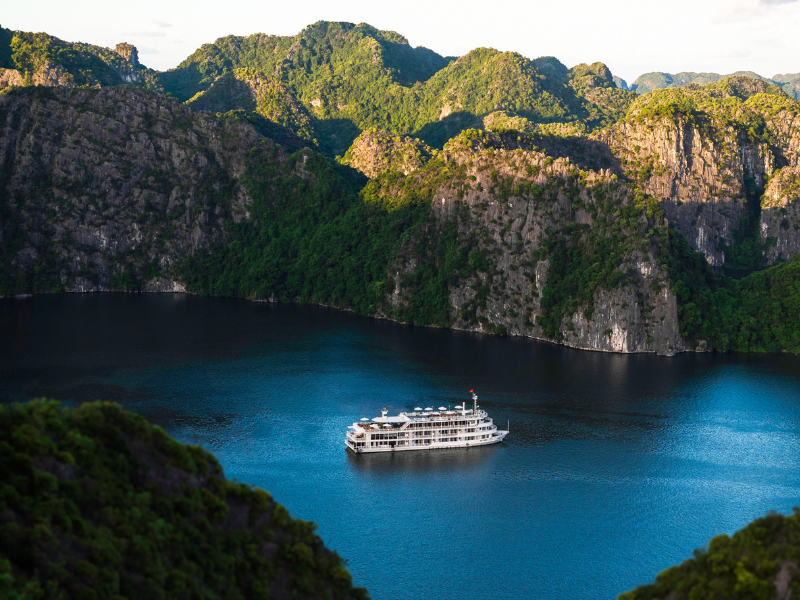
For those seeking a longer immersion across both Halong Bay and Lan Ha Bay, The Au Co’s signature 3-day route spans the full corridor from Halong’s central heritage zone through to the quieter reaches of Lan Ha Bay, including access to the Dau Be island cluster. The Au Co focuses on cultural depth alongside natural exploration, combining visits to fishing villages, cave formations, and saltwater lakes within a single continuous voyage.
Travelers arriving from Hanoi can use Bhaya’s shuttle bus transfer service, which departs each morning and connects Hanoi directly to the cruise departure point, removing the logistics of independent transport. The road journey takes approximately 2.5 to 3 hours via the Hanoi – Halong expressway.
Frequently Asked Questions
Is Ba Ham Lake the same as Halong Bay?
No. Ba Ham Lake is located within the Ha Long Bay – Cat Ba Archipelago UNESCO World Heritage Site, but it lies specifically in Lan Ha Bay, not the central Halong Bay area. Lan Ha Bay belongs to Hai Phong province, while Halong Bay proper is administered by Quang Ninh province.
Can you swim in Ba Ham Lake?
Swimming access depends on current cruise operator policies and local authority regulations, both of which may change over time. As of 2026, visitors should confirm whether swimming is permitted with their cruise operator before departure.
How long does it take to kayak through Ba Ham Lake?
A complete kayaking route through all three interconnected lakes and their cave passages typically takes 45 minutes to 1.5 hours. The exact duration depends on your group’s pace, guide schedule, and tidal conditions.
Is Ba Ham Lake accessible on a day trip, or does it require an overnight cruise?
Ba Ham Lake is situated on Dau Be Island, about 45–55 minutes by boat from Cat Ba Town. Although it can be reached on a long day trip from Cat Ba Island, most visitors experience the lake as part of a 2-day or 3-day Lan Ha Bay cruise itinerary.
Is Ba Ham Lake suitable for children or non-swimmers?
Yes. Ba Ham Lake is suitable for most visitors, including children, when exploring by sampan rowing boat instead of kayak. The enclosed lakes are calm, and the cave passages are navigated at low speed. Non-swimmers should inform their guide before departure so appropriate seating arrangements can be made. Life jackets are provided for all water-based activities.